

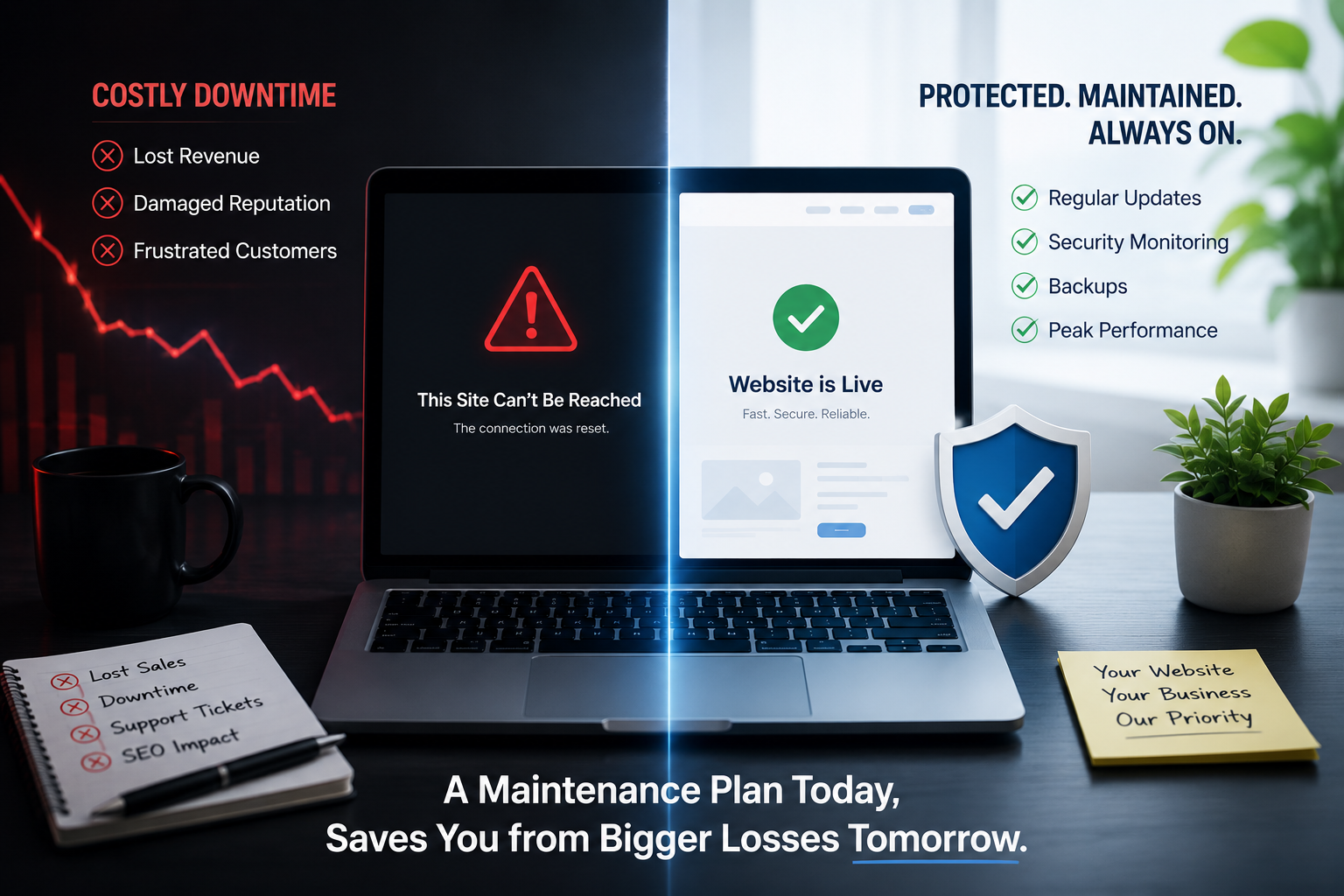
Your website is not just a digital asset. It is often the first interaction people have with your business, the place where decisions are made, and in many cases, where revenue is generated.
Yet many businesses treat their website as a one-time project. Once it is launched, it is left untouched until something breaks. And when it does, the impact is immediate—lost leads, failed transactions, and a damaged brand reputation.
A dedicated website maintenance plan exists to prevent exactly that. It ensures your website continues to perform, adapt, and support your business without interruptions.
What a Website Maintenance Plan Really Means
A website maintenance plan is not just about occasional updates. It is an ongoing process that keeps your website secure, optimized, and fully functional at all times.
It involves continuously monitoring your website’s health, applying updates before issues arise, and making improvements that keep your site aligned with both user expectations and evolving technology.
When done properly, maintenance becomes invisible to your users—but critical to your business.
The Real Cost of Website Downtime
Downtime is rarely just a technical issue. It is a business problem.
When your website is unavailable, even briefly, potential customers leave. Existing users lose trust. Search engines begin to notice inconsistencies in performance. Over time, these small disruptions compound into measurable losses.
This is one of the most overlooked reasons businesses struggle with their digital platforms. Many of these issues tie back to poor planning and lack of ongoing support, often leading to technology project failures.
Security Is Not Optional
Security plays a critical role in any website maintenance plan, and more importantly, it directly impacts your business stability. When websites are not updated regularly, they quickly become easy targets for attacks. For instance, outdated plugins, themes, or integrations create vulnerabilities that hackers can exploit without warning. As a result, even a single breach can lead to data loss, unexpected downtime, or, in severe cases, complete site failure.
To prevent this, consistent maintenance keeps your website protected at all times. By applying updates as soon as they are available, strengthening security layers, and proactively identifying risks, you can stop threats before they turn into serious problems. Furthermore, this becomes even more important for websites that rely on external integrations, payment systems, or APIs, because these systems introduce additional entry points that require continuous monitoring and protection.
Keeping Your Website Running Without Interruptions
A well-maintained website rarely experiences unexpected downtime because issues are identified early and resolved quickly.
Maintenance includes continuous monitoring, which allows problems such as server instability, plugin conflicts, or performance drops to be detected before they affect users. Instead of reacting to failures, you prevent them from happening in the first place.
For a business, this means stability. Your website continues to support your operations without disruption, regardless of traffic or technical complexity.
Performance Directly Impacts Growth
Website speed and performance are not just technical metrics. They directly influence how users interact with your business.
A slow website leads to higher bounce rates, lower conversions, and a poor user experience. Over time, this affects both revenue and brand perception.
Through regular optimization, maintenance ensures your website remains fast and efficient. Databases are cleaned, unnecessary scripts are removed, and performance improvements are implemented consistently.
This becomes especially important as your business grows, which is why many companies investing in scalability rely on custom WordPress development for growing businesses to support long-term performance.
Protecting Your Search Engine Rankings
Search engines prioritize websites that are reliable, fast, and secure. If your website begins to show errors, slow load times, or security issues, your rankings will gradually decline.
Maintenance plays a critical role in maintaining your visibility. It ensures your site remains technically sound, free from broken pages, and aligned with SEO best practices.
In a competitive digital landscape, even small technical issues can affect how your website performs in search results. This is particularly relevant today, where search is evolving rapidly with AI-driven search results and modern SEO strategies.
Backups: Your Safety Net
No system is immune to failure, and whether issues arise from human error, server problems, or unexpected bugs, they can occur at any time; therefore, relying on luck is never a safe approach. What truly matters, however, is how quickly you can recover when something goes wrong. For this reason, a proper maintenance plan includes regular backups that allow you to restore your website quickly and efficiently. Instead of rebuilding everything from scratch, you can return to a stable version almost instantly, which in turn minimizes downtime and reduces disruption. As a result, your business continues to operate smoothly without major interruptions, and ultimately, backups act as a reliable safety net that protects your data, ensures continuity, and keeps your operations running without risk.
Adapting to Changing Technology
Technology is constantly evolving, and websites must keep up to remain effective. Browsers release updates, plugins introduce new features, and third-party integrations frequently change their requirements. These updates may seem small, but they can significantly impact how your website functions over time. Without regular maintenance, your website can quickly fall behind. Outdated components may lead to broken features, failed payment processes, compatibility issues across devices and browsers, and a decline in overall user experience. In some cases, essential functionalities may stop working entirely, affecting both customer trust and business operations. Ongoing maintenance ensures your website stays aligned with the latest technologies. It includes updating software, testing compatibility after changes, and optimizing integrations so everything continues to work smoothly. This not only keeps your website functional and secure but also prepares it to support new features and future growth without disruption.
Supporting Long-Term Business Growth
As your business expands, your website naturally becomes more complex. With increasing traffic, evolving features, and growing integrations, your platform must handle more than it did in the early stages. As a result, what once worked for a smaller setup may no longer be enough to support rising demands. Without proper maintenance, however, this growth can quickly lead to instability.
For example, performance issues, slower load times, system conflicts, and unexpected downtime may begin to appear. Consequently, your website may struggle to handle increased activity and added functionality. Over time, this directly impacts user experience, reduces conversions, and affects overall business performance. On the other hand, a dedicated maintenance plan ensures your website scales smoothly alongside your business. In addition, it supports continuous development, keeps performance optimized under higher traffic, and ensures that new features and integrations work seamlessly. Because of this, your website remains stable, secure, and capable of handling growth without disruption.
Furthermore, many businesses choose to work with dedicated developers as part of their maintenance strategy. This approach not only provides continuous technical support but also eliminates the need to build and manage a full in-house team. As a result, businesses can focus more on growth while their technology continues to perform reliably
Final Thoughts
A website is not something you build once and forget. It is a system that requires continuous attention. A dedicated website maintenance plan transforms your website from a fragile asset into a reliable business tool. It prevents downtime, protects your data, and ensures your platform continues to perform at its best. In the long run, maintenance is not an expense. It is an investment in stability, growth, and peace of mind.