

When businesses reach a point where their internal team is no longer enough, the next step is usually to look outside. This is where two common options come into play: team augmentation and outsourcing.
At first glance, they may seem similar—both involve working with external professionals—but in reality, they solve very different problems. Choosing the right one can directly impact how efficiently your projects run, how fast you scale, and how much control you retain over your work.
Understanding the Core Difference
The simplest way to understand it is this:
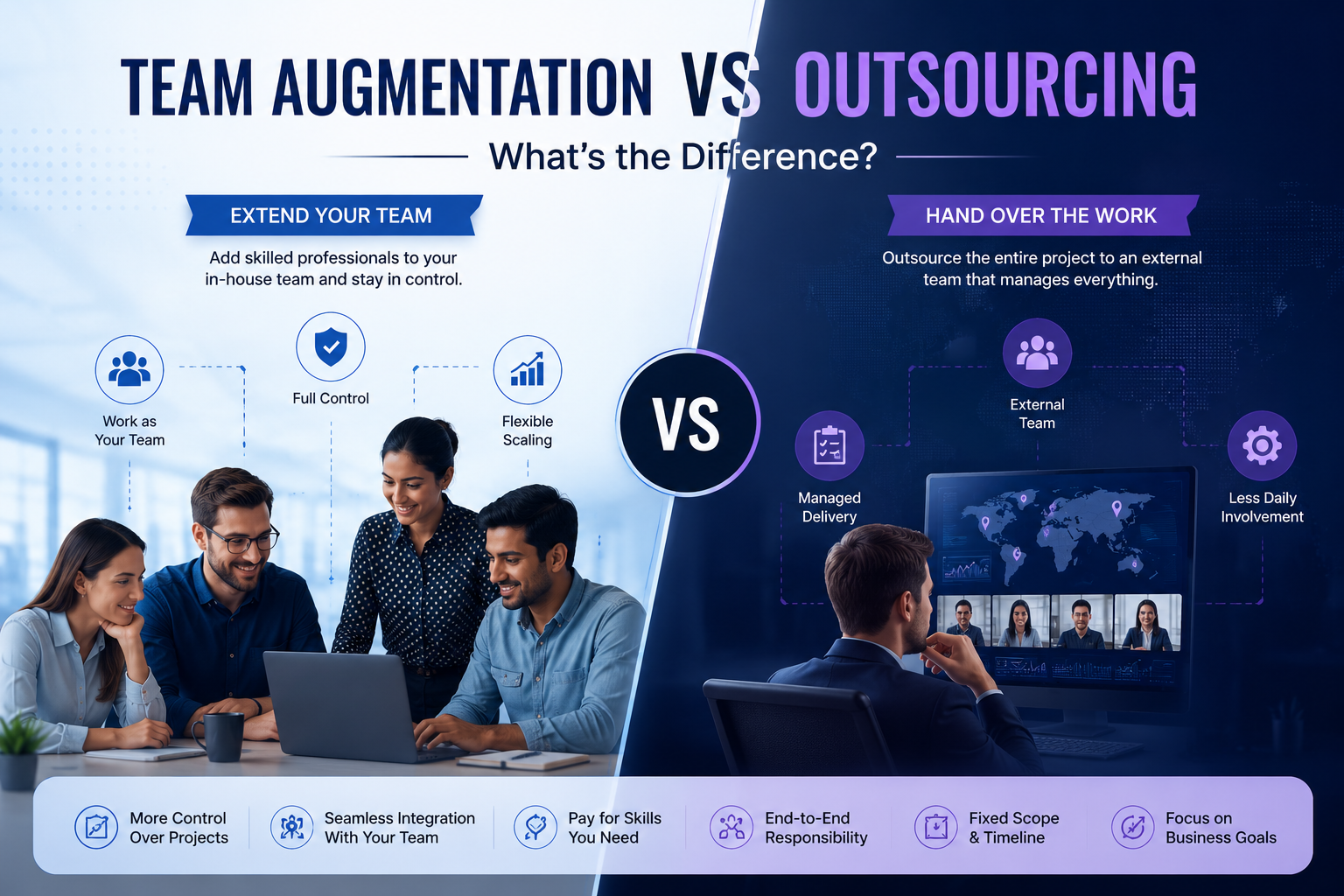
- Team augmentation adds people to your team
- Outsourcing hands over the work to another team
With team augmentation, external developers or specialists join your existing team and work alongside you. They follow your processes, attend your meetings, and contribute as if they were part of your company. This approach is often used by businesses that are trying to build a scalable tech team without hiring in-house, especially when speed and flexibility are critical.
Outsourcing, on the other hand, shifts responsibility. You define the requirements, and the external team takes care of execution. They manage the workflow, timelines, and delivery, while you stay focused on outcomes rather than daily operations.
Control vs Convenience
One of the biggest differences between the two models is control. With team augmentation, you stay in charge. You decide how things are built, how tasks are prioritized, and how the team operates. This is especially important for businesses working on evolving products, where decisions need to be made quickly and frequently.
Outsourcing offers convenience instead. It removes the need to manage people or processes. For businesses that don’t have a technical team or don’t want to be involved in day-to-day development, outsourcing can be a practical solution. This is also why many companies explore whether outsourcing makes sense for business owners, depending on how involved they want to be in execution.
Flexibility and Scalability
Modern businesses rarely operate in a fixed environment. Projects grow, change direction, or scale unexpectedly. Team augmentation fits naturally into this kind of environment. You can bring in one developer today, scale to five next month, and reduce again when the workload drops. It gives you the freedom to adjust without long-term commitments.
Outsourcing, however, is usually tied to defined scopes and contracts. While it can still scale, it’s not as fluid. Changes often require renegotiation, which can slow things down.
Cost Perspective
Cost is often one of the first things businesses consider. But the comparison isn’t always straightforward. Team augmentation allows you to pay only for what you need—specific skills, for a specific time. There are no additional overhead costs like hiring, training, or long-term benefits.
For businesses evaluating different models, it’s important to understand whether outsourcing development actually saves cost, as the answer depends heavily on project scope and long-term goals.
Outsourcing, on the other hand, often comes as a fixed package. While it may seem higher upfront, it includes management, delivery, and sometimes even strategy. The real question isn’t which is cheaper, but which gives you better value for your specific situation.
Speed and Execution
Speed matters, especially when launching products or meeting tight deadlines. With team augmentation, onboarding is quick. Skilled professionals can start contributing almost immediately, reducing delays in execution. This makes it ideal for businesses that already have a system in place but need extra hands.
Outsourcing takes a bit more time at the beginning. There’s a need for knowledge transfer, planning, and alignment. However, once everything is set, it can run independently without constant involvement.
When Team Augmentation Makes More Sense
Team augmentation works best when you already have a team and need to strengthen it.
It’s particularly useful when:
- You’re building or scaling a product
- You need specialized skills for a short period
- You want to maintain control over development
- Your project requirements are constantly evolving
This is especially relevant for companies working on custom software development projects or building scalable SaaS platforms where flexibility is essential.
When Outsourcing Is the Better Choice
Outsourcing becomes the better option when you want to step back and let someone else handle everything.
It works well when:
- You don’t have an internal development team
- You want end-to-end delivery
- You prefer focusing on business rather than execution
- Your project scope is clearly defined
For many businesses, outsourcing provides a structured and reliable way to get work done without managing technical complexity.
Finding the Right Balance
In reality, it doesn’t always have to be one or the other. Many businesses today use a combination of both. They might outsource an entire project while using team augmentation to support internal operations. Or they might start with outsourcing and later move to augmentation as they build their in-house capabilities.
As companies grow, they also start combining these models with AI automation and chatbot solutions to further improve efficiency and reduce manual workload.
Final Thoughts
Team augmentation and outsourcing are not competing models; they are different approaches to solving different problems. If your priority is control, flexibility, and scaling your existing team, team augmentation is the smarter choice. If your focus is convenience and full project delivery, outsourcing might be the better fit.
As businesses continue to evolve, the ability to choose the right model at the right time becomes a strategic advantage. And in many cases, that decision can define how efficiently a company grows.